By: Sonora Slater
Fall foliage faintly shows beyond a hazy swath of fog obscuring the skyline, save for a single tall street light trying valiantly to poke through. Two cars linger in the parking lot, and paired with them, two men talk, leaning back comfortably on their respective vehicles.
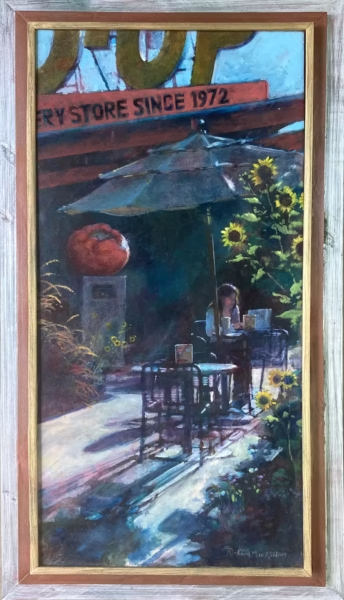
If you’ve lived in Davis for any amount of time, you likely haven’t just seen this moment—you’ve lived it. The same is true for many of Richard Max Kolding’s paintings, which focus on Davis scenes, and somehow manage to capture not just the visuals of day-to-day life in our small town, but also the feeling of those moments: sorting through produce at the farmers market, being hunched over a laptop at a table outside Peet’s Coffee downtown, or walking up the stairs of the Mondavi Center just before seeing a great show.
“People like the art visually,” Kolding said, sitting in his studio in West Davis, where he’s lived for decades. “But it also brings back memories.”
Nearly all of his art is of Davis—“It’s my life,” Kolding said, when asked why—and some of it does feature big landmarks or events. But much of it is smaller moments; street corners that to an outsider might look mundane, but to a local, remind them of their daily commute, their time as a student at UC Davis, or the mornings they’ve spent walking their dog around their neighborhood.
“I painted the Mondavi Center lobby because it’s a place that means something, [and tried to capture] the feeling of walking into the lobby,” Kolding said. “If [viewers] have shared that experience, it’ll mean something to them.”
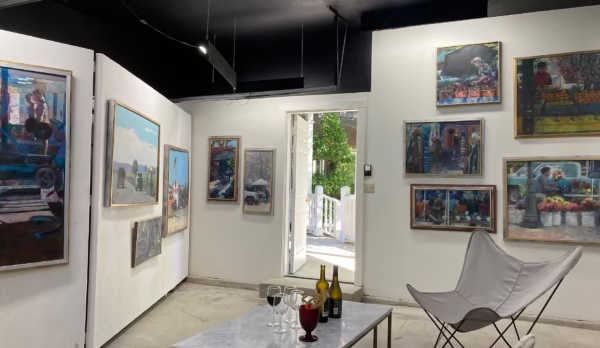
He displays these paintings in a garage gallery at his home, where he’s lived for decades after designing and building the house with his wife. They raised their five boys here. This is a space he’s created for neighbors to come over, look at his paintings in person, and talk about art. If you’re lucky, his wife has made cookies.
Although he hasn’t lived in Davis his whole life, his connection goes pretty far back—Kolding earned his degree in art at Sacramento State before shifting south to study illustration at the ArtCenter College of Design in LA. After that, he had a long career in commercial illustration, working on everything from magazine covers to children’s books and even Hallmark cards.
“I got very good at drawing commercial personified animals and cute kids,” Kolding said.
About 10 years ago, he started painting for himself. Although the finished product looks different from his commercial work, elements of what he learned in his career are useful for him today.
Working from photos of real scenes, Kolding typically takes many photos and arranges his painting as a sort of composite of several—whether that means compiling multiple people into one photo, modifying someone’s pose to make their actions clearer, or swapping out details.
But other aspects of Kolding’s style—his frequent use of backlighting and the dramatic shadow patterns he includes, aren’t necessarily the result of something he was taught. The way he sees it, it was exactly when he stopped trying to find a style that he discovered the one that was his.
“People say I have my own style, and ask, ‘How did that happen?’” Kolding reflected. “I think just a whole lot of drawing and painting. I got to the point where I stopped thinking about the style and just painted how I wanted to.”
Although it can be hard to put a finger on how exactly to develop a style of your own, Kolding said he tends to liken it to developing a signature.
“We start by learning to print in the lines,” Kolding explained. “You get good at that, and then go to script, and then from there you have to find your signature. Some people like to control a signature, some just do it and see what comes out. But when you stop thinking about it, that’s when you have it.”
Another thing that doesn’t really translate from work as a commercial artist? Being told by someone else when a painting is done. As a self-employed painter, Kolding said he finds himself asking this question constantly—but impressionism is an answer to the endless quest for perfection in a lot of ways.
Before the impressionists of the 1870s, there was a big focus on paintings being incredibly finished and polished, Kolding said, to the point where being able to see brushstrokes in a painting was considered sloppy. But with impressionism came an appreciation for the imperfection, for hazier figures and less realistic techniques, leaving room for interpretation.
“I get consistent feedback that people like a less finished look,” Kolding said. “They recognize my impressionist influence, and impressionism is really easy to enjoy.”
Although this doesn’t always help him know when it’s time to step away from a painting, it does make it easier to accept that even though most paintings might never truly feel completely done, sometimes it’s time to move on to something new.
Finding subjects and scenes to paint has always been easy. “It just hits me one day when I see it,” Kolding said, lamenting he can never paint as fast as he wants to.
Whether it’s a mom loading up her kids outside of Ace Hardware, or the moment he was visiting Monet’s gardens near Paris and decided instead of a simple still life scene of the same flowers one of his biggest inspirations had painted centuries earlier—he would capture the crowd of tourists.
“When I saw the tourists on the bridge, at first I thought, ‘Get out of my way!’” Kolding recounted, laughing. “But then I realized, no, that’s the picture. The human aspect interests me.”
Seeing people enjoy his art, whether in his studio or at the Davis Farmers Market, Kolding says, gives him hope for the future of art appreciation and the art industry.
“I have some reason to believe that people are craving handmade things,” Kolding said, citing encounters with his own recent customers, as well as the experience of seeing people crowded around a painting by Van Gogh in Paris, transfixed by brushstrokes frozen in time, as evidence. “People enjoy that signature, that connection, that form of communication.”
Artificial intelligence might be able to give you an itinerary for what to do in Davis—but it certainly couldn’t capture the feeling of waking up on a foggy morning, watching the lights of construction flash downtown at night, or seeing your bike’s shadow reflected next to you as you ride. Kolding can, and does—and with each visible brushstroke, he illustrates a tangible love for the city he lives in, and for the people who populate it.
Locals may find Kolding and his work at the Davis Farmers Market and the Davis Craft & Vintage Fair. Those interested in deeper connections may head to richardmaxkolding.com and email or call for a time to swing by in person.