
By: Sonora Slater
For any climber, there’s a unique kind of satisfaction that comes with reaching the top of a new route. It’s the feeling of accomplishing something you didn’t know you were capable of and pushing past roadblocks to (literally) reach new heights. And for participants at Davis Rocknasium’s new program for helping people with Parkinson’s disease rock climb, that sense of satisfaction in accomplishing something independently is one that may be infrequent—making the feeling of pulling up the wall successfully all the sweeter.
The program, which meets weekly, is part of a nationwide effort called Up ENDing Parkinson’s, a nonprofit started in 2012 with the goal of providing guided rock climbing opportunities for individuals living with Parkinson’s, a neurodegenerative disorder, with the goal of alleviating symptoms through physical exercise and mental stimulation.
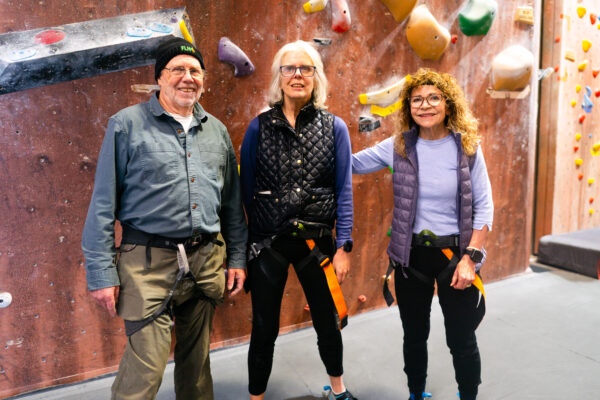
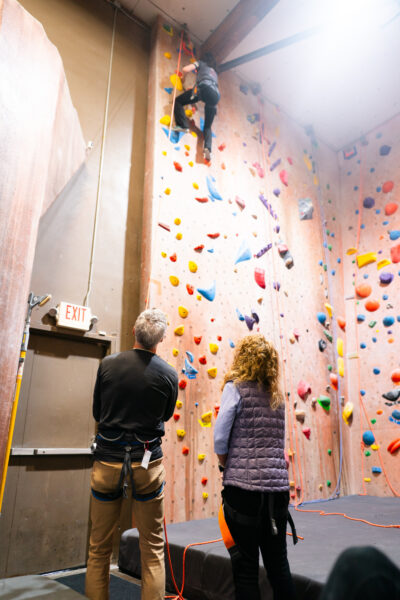
The Davis offshoot of the program began in January, and utilizes volunteer belayers and rock climbing harnesses to keep climbers safe and secure while allowing them to work through the task themselves, deciding their path up the wall and building up strength by climbing progressively more difficult routes.
“A lot of these people are very unstable, but they can’t fall, because they’re roped in,” Dave Turnquist, the Davis program’s head volunteer, explained. “It’s very, very safe. They can experiment and try things that maybe if they weren’t roped up, they wouldn’t want to try.”
According to Turnquist, their first meeting had just two participants. But a little over a month later, 18 climbers are signed up—including Carmen Bustos-Bennett.
Bustos-Bennett said that she first became interested in rock climbing when she saw someone on television talking about how the hobby had helped with her tremor, a common symptom of Parkinson’s. Bustos-Bennett, despite being afraid of heights, hoped that she might notice similar benefits from the exercise. Although she hasn’t noticed any major physical difference yet in the few weeks she’s been attending, she said that there has been a mental benefit from her efforts.
“It’s a mental challenge, like you’re conquering something,” Bustos-Bennett told The Dirt. “Achieving something you were afraid of.”
Part of the thought behind the program is the scientific benefit climbing can have for Parkinson’s patients, Turnquist said, from an improvement in dexterity and balance, to positive mental stimulation via strategizing how best to move up the wall.
But perhaps equally as important as the scientific benefits, as echoed by participants, is the positive mental benefit of accomplishing something independently. Karli Leffler, Rocknasium’s general manager, said her dad has been living with Parkinson’s for more than a decade, and that her experience with the disease has made her especially aware of how freeing rock climbing can be.
“My dad’s had it for [around] 13 years now, and having to lean on people so hard for such little tasks I’m sure can feel so dehumanizing,” Leffler said. “The fact that these people can come and get on the wall and do the same things that Dave and I can do is amazing, and we really just want more people to be able to have that experience.”
Marianne O’Malley was diagnosed with Parkinson’s seven years ago, and since then has sought opportunities for regular exercise. Like Bustos-Bennett, O’Malley was initially trepidatious of rock climbing, but eventually decided to give it a go.
“I’m a 68-year-old woman, so the idea of climbing up on one of these concrete walls with little tiny handholds, was like, no, I’m not going to do that,” O’Malley told The Dirt. “But then I went, ‘Well, why am I saying no? Why don’t I give it a try?’”
So she did—and although she didn’t make it to the top on her first try, she did make it on her second.
“Lo and behold, suddenly I was at the top,” O’Malley said. “It was such an enormous sense of accomplishment of doing something that I never imagined myself to do even before Parkinson’s, but then you put a Parkinson’s diagnosis on top of it, and I never in my right mind thought I’d be able to do that.”
The first time Bustos-Bennett and O’Malley mustered up the courage to attend a session, they went together, knowing they’d have a friend there with them. Turnquist said the social aspect of the climbing sessions is a huge piece of what makes them not just successful, but also fun—sure, they have Parkinson’s in common, but now they also have a common goal of conquering the next climbing route.
“I had this enormous sense of doubt in my ability to do this,” O’Malley said. “I grew up in New York City—we don’t rock climb. I’m too old. My hair is white. I have Parkinson’s. I could define a million reasons why I can’t do this, so having people there cheering you on was huge.”
Details for those interested
The meetup takes place at the Rocknasium at 720 Olive Dr, Suite S every Wednesday morning from 10-11:30a. Entry is free, with just a $10 rental fee for shoes and a harness unless the participant already has their own equipment. After a quick warm up, three belayers are set up and climbers take turns rotating onto the wall and acting as a cheering squad for others.
Before participating, climbers have to do three things: First, register as a climber at rocknasium.com. Second, make an account on the Rocknasium website, go into their event calendar, and sign up as a climber for the Wednesday meet-up. And third, fill out a gym waiver, which can be done either online or in-person once climbers arrive at the gym. For anyone simply coming to observe a session, the first two steps are unnecessary but the third—filling out a waiver—is needed for anyone who will be in the gym.
O’Malley’s advice for anyone unsure of whether they should join?
“Give it a try,” she said. “What do you have to lose? It’s like nothing else—you’ll blow your mind with what you’re capable of.”