By: Norafiqin Hairoman for The Dirt
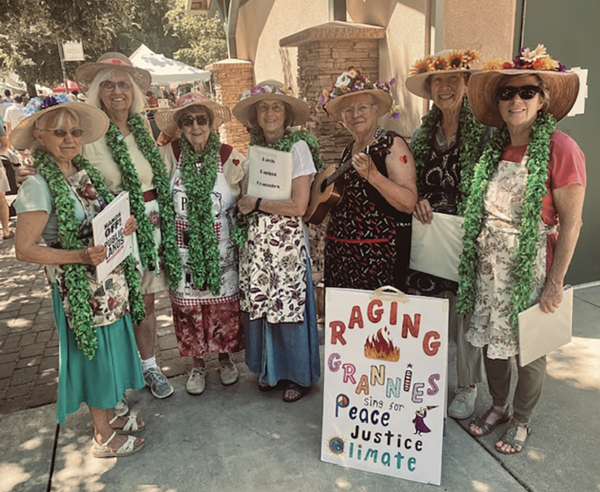
On a sunny Saturday at the Davis Farmers Market, you might first spot the hats with wide-brimmed florals, feathered fascinators, and a sprinkle of sequins. Then the aprons, the boas, the skirts. It all says “storybook grandma”—right up until the lyrics start.
The women in front of you are the Davis “gaggle” of the Raging Grannies, a local chapter of an international movement that began in Victoria, British Columbia in 1987, when a group of older women started staging theatrical protests against U.S. nuclear submarines in the harbor. The Davis group was founded in 2017 by Lynne Nittler and a few other politically active women, galvanized by the 2016 presidential election and inspired by those original Canadian Grannies.
Today, the Davis gaggle operates much like its sister groups across the U.S. and Canada. They’re independently organized but loosely connected through a shared website of songs and a lively “E-vine” for ideas, news, and fresh verses. Locally, administrative duties are shared by Lynne Nittler and Jeanette Vance, but everyone pitches in by suggesting actions, choosing issues, and helping to write and rehearse songs. What unites them is simple and sweeping: a desire to speak out against injustice and inequality, to protect the climate and environment for their descendants, and to advocate for peace, human rights, and economic justice.
They just happen to do it in granny hats.
“Granny gear shows that we have a sense of humor and suggests that we are acting out of love, not hate,” Robin Datel, one of the members, said. “We become less threatening to others, even if we are delivering messages that they disagree with.”
It’s not an accident. The “look” is a strategy. When passersby see a cluster of older women in aprons and boas, they don’t usually brace for confrontation. They think of their own families.
“When people see a group of ‘grannies’, it evokes the warm feelings most people have for their own grandmothers, who are often a source of comfort and wisdom,” explained Davis Raging Grannies member Jeanette Vance. “In a way, we are ‘the spoonful of sugar’ that makes it easier to swallow the medicine, and to face the need to get out there and take action.”
That “medicine” covers a lot of ground. “Issues of human rights, women’s rights, LGBTQ+ rights, social justice, climate change, and regional issues are all subjects of songs,” Cam Stoufer, another member, said. As the Raging Grannies are international, the Davis group can draw from a shared songbook which has lyrics composed by gaggles across the U.S. and Canada, as well as material they write or adapt themselves.
Songwriting, it turns out, is part craft, part puzzle, and part catharsis. For Vance, the message usually comes first.
“As important points to include come to mind, sometimes they trigger an association with patterns of existing lyrics in a familiar song,” she explained. “Then you can build more ideas into the existing framework and rhyming patterns in the song.”
One recent example: the holiday standard “Winter Wonderland.” In the original, the line goes, “Gone away is the bluebird; here to stay is the new bird.” In Vance’s hands, it became: “Gone away constitution; here to stay retribution.” It’s a tiny act of verbal judo that makes people laugh, then think. “Keeping a connection between the original song and the new lyrics can help people remember the message,” she said.
Transportation policy got similar treatment when the Grannies decided to sing about public transit and freeway expansion. “We wrote a song about the benefits of promoting public transit rather than adding more lanes for single-passenger cars on the freeway, and used Willie Nelson’s ‘On the Road Again’ as the tune,” Vance noted. Sometimes the chorus of a song is the spark: a catchy hook to build a whole protest anthem around.
The lyrics are sharp, but they’re calibrated. “An unexpected turn of phrase can make the message more memorable, and can emphasize for the listener how important we think an issue must be, if it is enough to make us use language that we normally might not,” Vance said. “We try to avoid lyrics that would be divisive and lead people to stop listening; we use humor to welcome people to think about a viewpoint that might be different than their own.”
In a time of information overload and deep political polarization, the combination of humor, harmony, and costume is part survival tactic, part counter-spell. Vance compared it to the inflatable animal costumes that showed up at recent “No Kings” rallies. “Using humor and ridicule to defend against tactics of fear and brutality can weaken their hold on us,” she said. It can “counteract a feeling of powerlessness and promote hope and a feeling of community and shared power to make a change.”
And people responded. Some with laughter, some with tears.
“When we sang for reproductive rights, one of our Granny’s daughters and granddaughter came to watch,” Vance recalled. “The daughter was moved to tears because she was so grateful to us for taking a stand on that issue which affects her and people her age but not us so directly.” The generation gap narrows in unexpected ways: elders singing about bodily autonomy for their daughters and granddaughters, recognizing that the stakes are different and still stepping forward.
At the Sacramento Women’s March, the feedback was more exuberant than teary. “It was rewarding to have groups of young women come over to sing along with us, or to take selfies alongside us,” Vance said. The visual contrast—gray hair next to pink hats, boas beside protest signs—became part of the spectacle. In the photos, you can see a through-line: activism as a life-long habit, not a phase.
“Most current Grannies grew up in an age of protest—calling for the end of the Vietnam War and advocating for women’s rights, civil rights, gay rights, clean air and water, etc.,” said Datel. “Many of us participated in those movements in our youth. Thus the idea of protest and advocacy has been a part of who we are for many decades.” She offered a metaphor: “We don’t stop brushing our teeth because we’re old, likewise we don’t stop protesting because we’re old. In addition, we recognize that getting together and singing is generally good for anyone, old or young, and combining that with trying to make the world a better place is hard to beat.”
That combination of joy plus outrage, community plus critique is what the Davis Grannies hope would linger after they pack up their lyric sheets and head home. “I hope that we can inspire more people to protest unjust policies when they see older people getting out to protest,” member Linda Moreland said.
The activism doesn’t stop at the edge of the market. It travels home in family group chats and holiday conversations. “My granddaughter is proud that I’m a grandmother and a Granny!” Moreland added. “Of course, she’s not a teenager yet!”
If you ask them about their “dream gig,” their ambitions are not modest. “[We’d like to perform] in front of a joint session of the U.S. Congress,” said Stoufer. Vance didn’t miss a beat: “I second Cam’s comment…it might inspire them to grow a spine.” You get the sense they’re only half joking.
Until that invitation arrives, the Davis Raging Grannies will keep doing what they do best: showing up at local rallies, city events, and the Davis Farmers Market; stitching new verses onto familiar melodies; and using every stereotype about “sweet older ladies” as a Trojan horse for serious, necessary conversations.
If you see them in the crowd—hats bobbing, lyrics flying, harmonies rising over the hubbub—they hope you’ll stop, listen, maybe sing along. And then, maybe, do something about the song that stuck in your head all the way home.
Email davisraginggrannies@gmail.com to connect with the gaggle and learn more.