
By: Craig Dresang, CEO, YoloCares
An unusual check came across my desk this month. It was made out for $10,000 and signed by a Davis donor and longtime friend of YoloCares. In the memo line at the bottom of the check he wrote, “Screw the intolerants.”
The donor’s cheeky act of generosity was a response to an article YoloCares published on diversity, equity, inclusion and belonging (DEIB), detailing the story of a Davis donor/foundation that withdrew financial support because they disagreed with the agency’s long-held position on diversity. Unfortunately, the one-time and now former donor interpreted the organization’s position on DEIB as a political statement rather than a clarification of founding institutional values.
This funder’s shift in support felt unwarranted, yet understandable since the country has been primed for a collision of values. Powerful voices are still launching attacks on institutions that overtly foster diversity and inclusion. Programs designed to bring people together have been remade as wedges to divide whole groups of otherwise neighborly folks. Since hospice in America was an outgrowth of the Civil Rights Movement, the change in climate has felt like an affront on traditionally held values in healthcare. Equity in care (and employment) has always been a central doctrine for end-of-life care providers. A history of the movement shows that early hospice providers were at the forefront of caring for the first waves of AIDS patients; those who have been marginalized, unhoused, uninsured; and immigrants who have little to no access to healthcare.
A year ago, a handful of constituents and employees were waiting to see how YoloCares would respond to a changing national climate on DEIB. Their curiosity was piqued following a slew of executive orders from the White House to end the government’s DEIB programs. Many companies took the government’s lead and curtailed and/or eliminated their diversity initiatives. Suddenly, decisions related to DEIB were being made from a place of fear instead of fairness. Business leaders were warned that their embrace of DEIB programs could result in governmental retaliation. There were threats of financial penalties, various forms of harassment, canceled contracts, and loss of business.
Under pressure, IBM scraped its most meaningful diversity initiatives. An internal company memo referenced, “inherent tensions in practicing inclusion.” Farm equipment manufacturer John Deere said it would no longer support “cultural awareness” events. The nation’s largest newspaper publisher announced that it would stop publishing diversity data, scrubbing its website to remove any reference about inclusion. The nation’s chief diversity officer was abruptly kicked out of a job, and the Department of Education banned every institution of learning (preschools to universities) from recognizing the value of diversity.
Meanwhile, at YoloCares, constituents from six counties kept asking where the agency stood in this new environment. A fair question since YoloCares has received more than $2 million over the last six years to address disparities in care for marginalized and underserved populations.
In response to questions and concerns from the community, YoloCares published an article during Black History Month, featuring the personal and professional journey of its black female board chair and former healthcare CEO. As it turned out, the candor of her real-life experience was simply a bridge too far for a few individuals. A line was drawn in the sand and the idea of future funding evaporated like valley fog.
In the article, Jackie Clark, YoloCares board president, said, “The national move away from diversity, equity and inclusion (DEI) and affirmative action, is deeply troubling. Contrary to some common beliefs, there are no hiring quotas attached to affirmative action or DEI. Historically, Congress has, in a bipartisan fashion, created federal procurement programs to counter the effects of discrimination that have raised artificial barriers for businesses owned by disadvantaged individuals, including women and minorities.” Clark continued, “Affirmative Action simply gave me, and others, a seat at the interview table. It afforded me the opportunity to show what I could bring to a position. That’s it. The rest was on me.”
In every corner of American industry, and especially in healthcare, Clark said, “We should hire the best and the brightest, and understand that excellence is not confined to any one demographic.” Some interpreted those words as a political statement. They were not.
A local six-figure funder/foundation dismissively withdrew future support because of the organization’s publicly stated commitment to diversity and inclusion. Ironic that it happened during Black History Month. One family member familiar with the situation said, “You should zip your lip, or lose support.” Her comment made me wonder why we were being bullied into a betrayal of our, and the healthcare industry’s, longstanding values.
For nearly 50 years, our organization has provided individualized end-of-life care and unparalleled support—without bias and without condition—to every person regardless of political affiliation, religion, gender, sexual orientation, socioeconomic status, physical or mental ability, background, personal ideology, or even citizenship. Period.
Moreover, the healthcare industry’s core ethical principles have long demanded justice, along with autonomy, beneficence, and nonmaleficence. Justice in healthcare ensures fairness, equity, and impartiality in the distribution of healthcare resources. History has shown that equity requires intentionality. Intentionality necessitates clearly stated goals and values.
Justice in healthcare should not be controversial. In fact, whenever and wherever injustice exists, there is a professional and moral obligation to call it out and address it. As Martin Luther King Jr. famously pointed out during the 1966 Medical Committee for Human Rights Convention in Chicago, “Of all the forms of inequality, injustice in health is the most shocking and inhumane.”
When it comes to politics, YoloCares has always remained apolitical. While the organization’s core values and beliefs could be manipulated into a political statement, they are not. Afterall, the agency’s patients, families, clients, 100+ staff members, 200 volunteers, advocates, and thousands of champions reflect the political landscape of America.
Every faith community under the sun would—and has—backed the agency’s core values of dignity, respect, compassion, and inclusion. From priests and rabbis to shamans and atheists, faith leaders and secular humanists recognize these core values as universal principles. They represent the agency’s moral code: a statement that each life matters. No matter what.
Multiple studies, particularly from McKinsey & Company, demonstrate the significant value of diversity in the workplace. Companies with higher levels of gender and ethnic diversity tend to outperform their peers financially. In addition, companies with diverse teams show improved innovation, decision-making, and market capture abilities. Companies in the top quartile for diversity are more likely to have superior financial returns compared to those with lower diversity levels.
Valuing and connecting with fellow humans who are different from each other has been twisted into political theatre. Yet, it has always been a moral and spiritual challenge that demands us to answer: what kind of humans do we aspire to be?
For YoloCares, the cost of inclusion has meant the loss of a few dollars and a friend or two—as well as increased support from those who know us well. Living our values carries both consequences and benefits. Remaining silent on such critical human decency issues would imply an abandonment of our moral drivers and founding spirit, a price YoloCares will never be willing to pay.
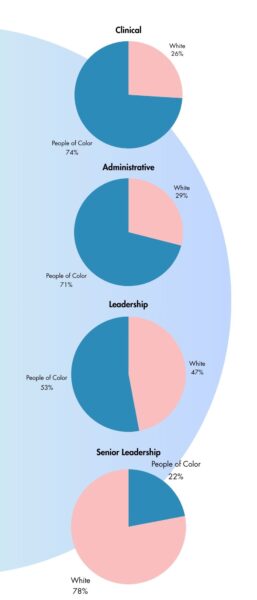
Workforce Diversity by Organizational Level; source: YoloCares Staff Demographic Survey 2026
Read more about the connection between the Civil Rights Movement and the birth of hospice, and about YoloCares’ distinct approach to patient care, in Dresang’s book End of Life Ethics In A Changing World, published by the Hospice Foundation of America. For more information, or to purchase, head to hospicefoundation.org.
YoloCares is a non-profit, community-based healthcare organization providing specialized hospice, palliative care, caregiver support, and bereavement services, with a focus on dignity, compassion, and supporting vulnerable individuals regardless of their ability to pay. YoloCares has served Yolo, Solano, and surrounding counties for more than 45-years.


