
By: Margaret Spiegel for The Dirt
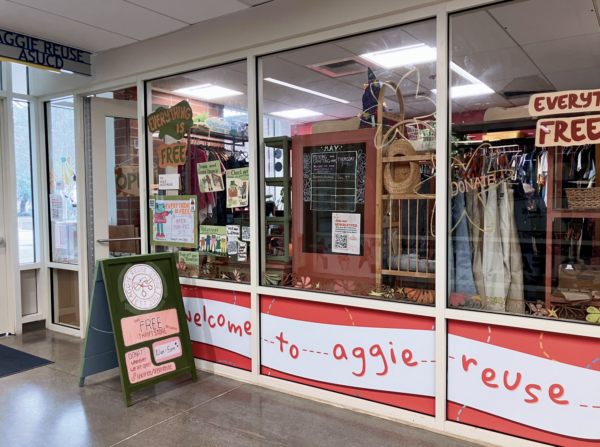
It’s 10 a.m. and the Memorial Union is already full of students rushing about, maybe grabbing a snack or a drink from the CoHo before class or troubleshooting the printer that works about half the time. Between the chaos, there’s a room off to the corner you might accidentally miss if you aren’t already in the know. Just past the help desk on the way to the Death Star building: Aggie Reuse.
Aggie Reuse is a free (yes, really! free!) store that runs entirely on donations and dedicated volunteers. And it’s not just for the students of UC Davis, it’s for the whole Davis community. Because it’s a small store and there’s regular foot traffic and donations, the selection is constantly changing. They have an assortment: professional clothing and cute summer gear, school supplies, miscellaneous kitchen utensils, and fabric. In the past, Aggie Reuse has run clothing drives for professional clothes in an effort to support students and community members.
There’s more to the sustainability of Aggie Reuse than the items in the shop. The Aggie Reuse teams practice sustainability in all of what they do, whether that means modifying events to use items they already have or renting items instead of buying new. And because the Aggie Reuse store is part of UC Davis, of course they have data and methods of tracking their impact in the community.
“We have our own tracking website that was built in conjunction with ASUCD IT,” Aggie Reuse Unit Director Kate Richards told The Dirt. “We use it to track a mix of things: when a person comes into the store, when we are given a donation, and which items are checked out.” This data informs the funding Aggie Reuse gets from ASUCD, but it also gives the store’s teams an idea of how they can improve community accessibility and environmental impact.
The data team figures out the metric amount of carbon emissions diverted by calculating the weight of the items checked out. For example: the average coat will weigh more than the average long-sleeve shirt, and the carbon emissions are based on the mass of the items diverted from the landfill (which, as an added benefit, also means that item won’t need to be purchased first-hand).
“The data is really important for us to know what’s going on so we can figure out ways to make the store better,” Richards said.
Case in point: last year, the data team realized the store’s older demographic was coming in around the end of the day. In response to this, the store expanded their hours on certain days to increase accessibility to the working population.
Aggie Reuse also practices sustainability by encouraging students to mend their clothing, giving students the tools to do so at mending events. My own experience of these events has been warm and welcoming: there are the event regulars, but there are also new people every time. The friendly energy of the event creates a space where people feel comfortable talking to people they haven’t met before (and maybe sewing patches to pants while they talk).
“Each mending event has a theme that’s somewhat tied to upcycling or altering clothing in some way,” design team member Julia Holton said.
Her favorite event was one where attendees made tiny skeletons out of soda tabs. Though there’s always a theme for the events, it’s also a space where folks have open access to craft supplies, from buttons and thread to felting supplies, to mend fabric items or craft something outside the theme. In the past, Aggie Reuse has collaborated with FADS (Fashion and Design Society) and the CoHo on their mending events and hopes to collaborate with other sustainable campus groups in the future.
If you have a craft or mending activity you are interested in leading as an Aggie Reuse mending event, fill out this form: https://forms.gle/ReTChjz3WgxTPSPMA
If you’re interested in volunteering at Aggie Reuse, want to learn more about events, or just want to stop by, follow the Aggie Reuse Instagram for regular updates and a very helpful linktree: @aggiereusestore